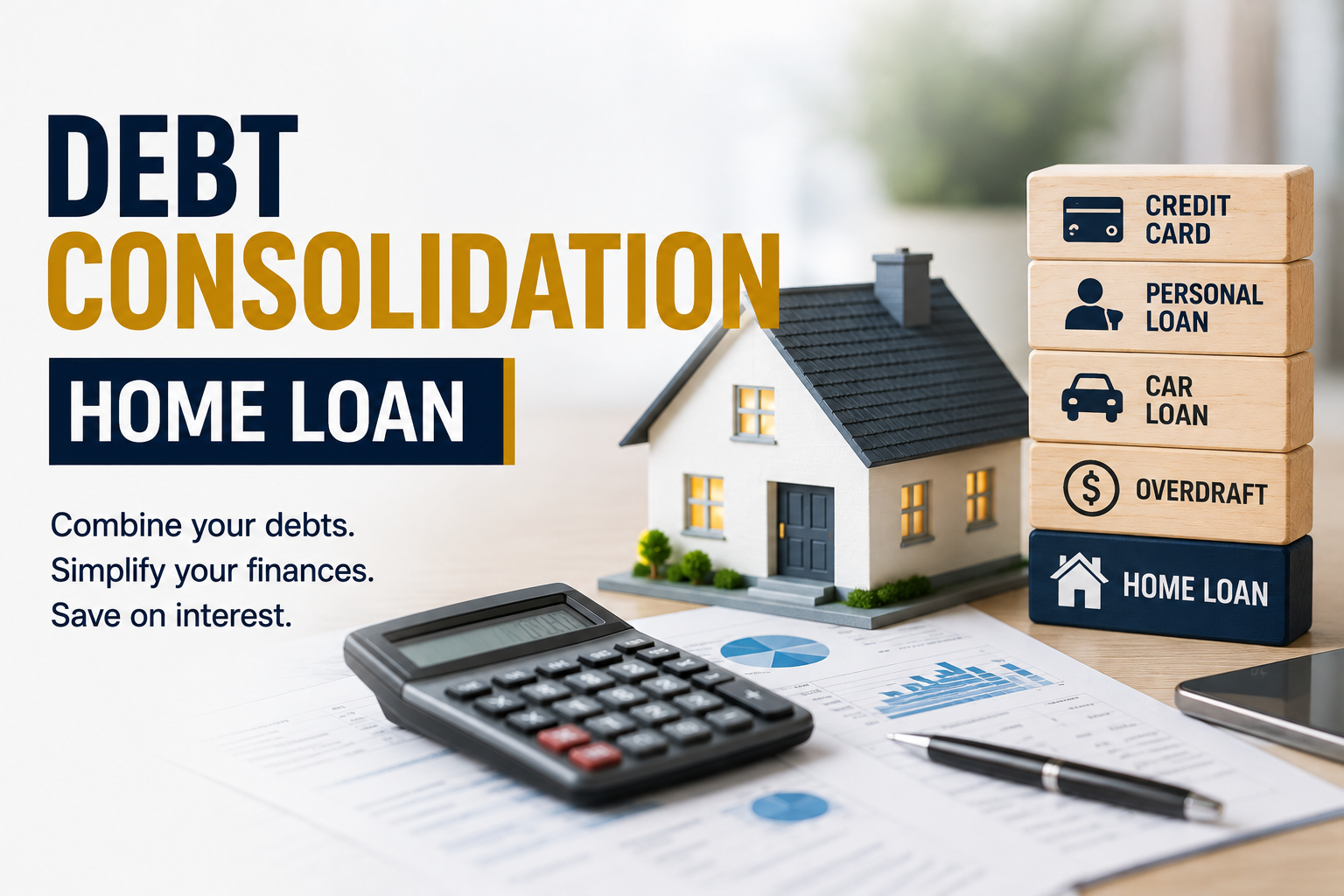
Debt Consolidation
Home Loan
Managing multiple debts such as credit cards, personal loans, and car loans can be stressful and expensive. A Debt Consolidation Home Loan allows you to combine these debts into your existing mortgage, giving you one simple repayment instead of several.
At Supreme Mortgage & Finance, we help borrowers assess whether debt consolidation is the right strategy and guide you through the process of refinancing to achieve better financial control.

Why Consolidate Your Debts?
Bringing your debts together into one home loan can offer several advantages:
One simple monthly repayment
Potentially lower interest rates compared to credit cards and personal loans
Improved cash flow
Easier budgeting and financial management
Opportunity to refinance to a more competitive home loan rate
What is Debt Consolidation?
Debt consolidation involves combining multiple debts—such as credit cards, personal loans, car loans, and store cards—into a single loan, usually your home loan. By refinancing your mortgage and accessing available equity, you can pay off those debts and roll the total into your home loan.
This leaves you with one monthly repayment instead of several, simplifying your finances and potentially reducing your overall interest costs.
How Does It Work?
To consolidate debts, you need sufficient equity in your property. Equity is the difference between your home's value and the outstanding mortgage balance.
Sarah's situation:
- Home value: $700,000
- Current mortgage: $400,000
- Available equity: $300,000
- Debts to consolidate: $60,000 (credit card, personal loan, car loan)
By refinancing, Sarah can borrow an additional $60,000 (secured against her home) to pay off those debts. Her new mortgage balance becomes $460,000, but she now has only one loan to manage.
Lower Interest Rates Save You Money
Home loans typically have much lower interest rates than credit cards (which can exceed 20% p.a.) and personal loans (often 8–15% p.a.). By consolidating, you can significantly reduce the interest you pay on your debts.
This difference can save you thousands of dollars in interest over the life of your loan.
Improved Cash Flow
Consolidating your debts can lower your total monthly repayments, freeing up cash for other expenses or savings. By extending the loan term (e.g., spreading the debt over the remaining life of your mortgage), your monthly payments can become more manageable.
However, be mindful that a longer loan term may mean you pay more interest overall—so it's important to balance cash flow with total cost.
Simplify Your Budget
Managing multiple debts with different due dates, interest rates, and minimum payments can be confusing. Consolidation gives you one fixed repayment, one interest rate, and one statement—making it easier to stay on top of your finances and avoid missed payments.
Consider the Costs
While debt consolidation has many benefits, there are costs to consider:
- Refinancing fees (discharge, application, valuation)
- Potentially higher LVR, which may trigger LMI
- Longer loan term could mean more total interest
Always weigh these costs against the potential savings and improved cash flow.
When to Avoid Consolidation
Debt consolidation isn't right for everyone. Avoid it if:
- You don't have enough equity in your home.
- Your credit card balances are small and can be paid off quickly.
- You are close to paying off your home loan (extending the term may cost more).
- You have a history of accumulating new debt after consolidation—this can lead to a debt cycle.
Get Professional Advice
Debt consolidation is a significant financial decision. A mortgage broker can help you compare lenders, understand fees, and find the most competitive refinancing option. They can also guide you on whether consolidation aligns with your long-term goals.
At Supreme Mortgage & Finance, we offer personalised assessments to help you make an informed choice.